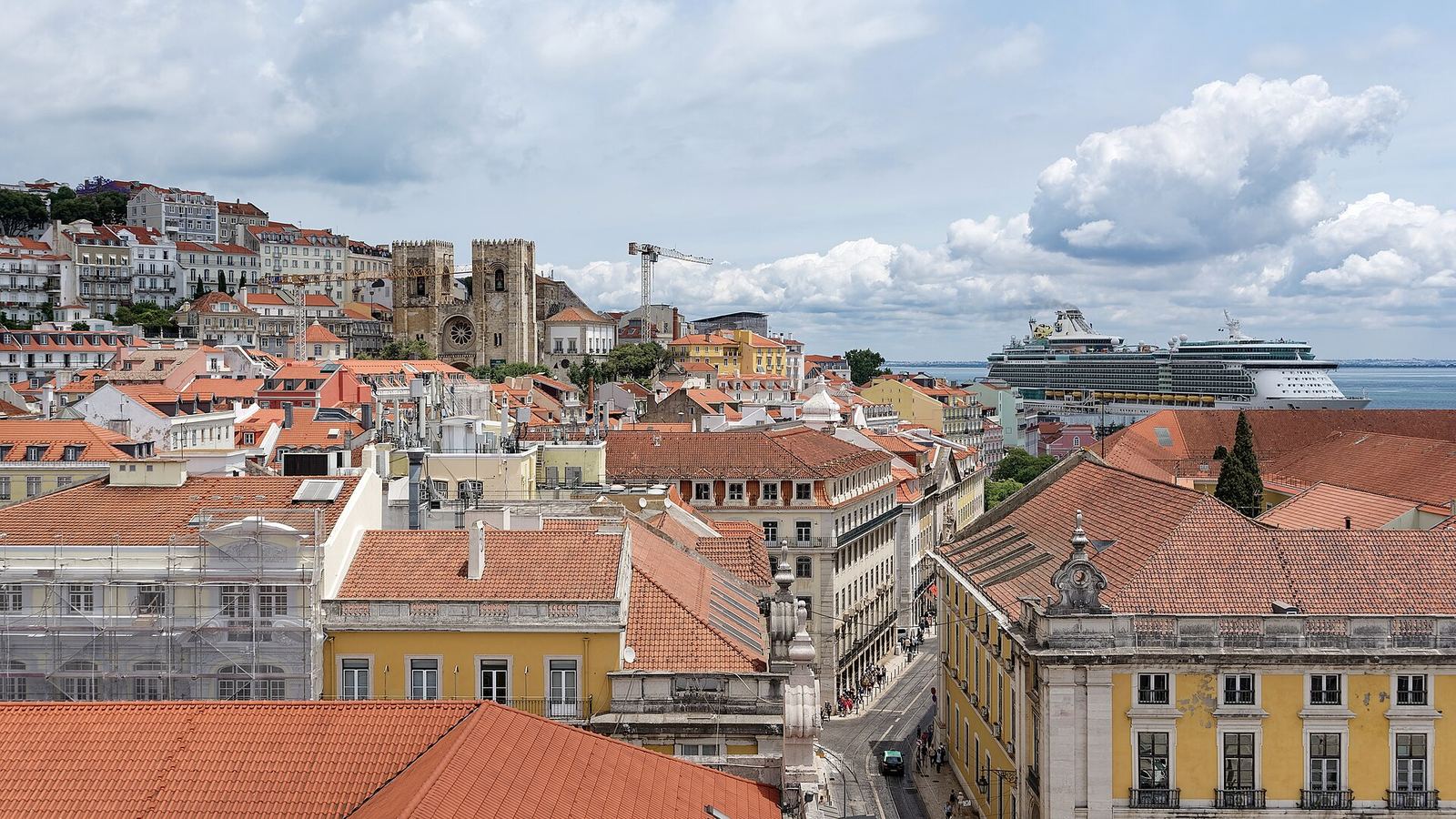
A fortress church built on a mosque, Saint Anthony's font, and the earthquake of 1755
When Afonso Henriques captured Lisbon in 1147, one of his first acts was to give the city a cathedral, dedicated to Santa Maria Maior. Built of heavy stone with battlemented towers, it was as much a stronghold as a church.
Over the centuries it gained a Gothic cloister and ambulatory, lost much in the earthquake of 1755, and was restored in the 20th century to the Romanesque look it has today.
Afonso Henriques, the first king of Portugal, takes Lisbon from the Moors with the help of crusaders, and orders a cathedral built on the site of the main mosque.
The relics of Saint Vincent, guarded by ravens according to legend, are brought from the Algarve to the cathedral.
Fernando de Bulhões, the future Saint Anthony of Padua, is born nearby and, tradition says, baptised in the cathedral.
King Dinis begins a Gothic cloister behind the church, on top of the old city's Roman and Islamic remains.
Afonso IV rebuilds the east end with a Gothic ambulatory, intended as a royal pantheon.
The earthquake and fire of 1 November damage the cathedral badly; the Gothic chapel collapses and parts are rebuilt.
The cathedral is classified as a National Monument.
Restorers remove many later additions and rebuild the rose window to give the façade its medieval look.
Archaeologists uncover a Roman street, Islamic-era houses and the remains of the mosque under the cloister.
After debate over plans for the site, the remains of the mosque are to be preserved and shown in place.
Saint Anthony, known to the world as Anthony of Padua, was born Fernando de Bulhões in Lisbon in 1195, in a house where the Church of Santo António now stands, just across from the Sé.
He was baptised in the cathedral's font and studied at its school before joining the Augustinians and later the Franciscans.
Lisbon still celebrates him every June. On the night of 12 June the city fills with street parties, grilled sardines and parades, and on the 13th, his feast day, a procession leaves from the church next to the cathedral.
The Sé was built in the Romanesque style of the 12th century: a Latin-cross plan, a barrel-vaulted nave with a triforium gallery, and a façade framed by two crenellated towers, like a castle gate.
The Gothic ambulatory added in the 14th century, with its radiating chapels and carved tombs, and the cloister built around the old Islamic and Roman city, show how the cathedral grew with Lisbon.
The Alfama & castle walk includes a guided visit of the cathedral. See the tour →
Add Santo António and São Vicente de Fora on a small-group walk. See the walk →
Open Monday to Saturday. Tickets €7, with the choir, balcony and Treasury included.